What tariffs has Trump imposed, and what was the rationale behind them?
By Muhammad MubashirPublished On 25 Feb 2026

US President Donald Trump has introduced a new 10% global tariff rate after the Supreme Court ruled that the majority of tariffs he introduced in 2025 were illegal.
Trump argues that his import taxes have boosted US manufacturing and created jobs. But critics say they have put up prices for American consumers and have disrupted and damaged the global economy.
It is thought the new 10% duty will replace the individual rates that were negotiated between the US and dozens of its trading partners - including the UK, India and EU - after the global tariffs were introduced.
What are tariffs and how do they work?
Tariffs are taxes on imported goods.
Typically, the charge is a percentage of a good's value.
For example, a 10% tariff on a $10 product would mean a $1 tax on top - taking the total cost to $11 (£8.17).
The tax is paid to the government by companies bringing in the foreign products.
These firms may pass some or all of the extra cost on to their customers, which in this case means American consumers and other US businesses.
Companies may also decide to import fewer goods.
Why is Trump using tariffs?
Trump says "tariff" is his favourite word, and has for decades repeatedly hailed them as a way to boost the US economy.
He argues they increase the amount of tax raised by the government, encourage consumers to buy American-made goods and boost investment in the US from foreign companies.
He also wants to reduce the US trade deficit - the gap between the value of goods it buys from other countries and those it sells to them.
The president argues that the US has been exploited by "cheaters" and "pillaged" by foreigners, and that tariffs correct this imbalance.
Trump has used different bits of legislation to introduce taxes against individual countries and on particular goods.
Many tariffs that he has announced have since been amended, delayed or scrapped altogether.
Trump has also used tariffs to pursue his wider political agenda.
When he first threatened new duties against China, Mexico and Canada, he said the countries had to do more to stop migrants and the illegal drug fentanyl reaching the US.
In January 2026, Trump said the US would apply a 25% tariff to Iran's trading partners, after Tehran cracked down on anti-government protests.
And in the same month, he threatened additional tariffs on eight European countries which opposed his plans to take over Greenland, before backing down.
How Japan sparked Trump's 40-year love affair with tariffs
What did the Supreme Court say and how will Trump's 10% tariff work?
On 20 February, the US Supreme Court said that Trump had exceeded his authority when he used emergency powers to introduce tariffs on specific countries without approval from Congress.
That ruling affected all tariffs Trump brought in under the International Emergency Economic Powers Act (IEEPA).
That includes the first tariffs Trump announced in early 2025 which targeted Mexico, Canada and China.
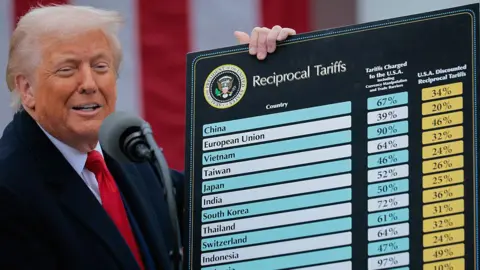
It also covers those announced on Trump's so-called "Liberation Day" in April 2025, when the president set out tariff rates of up to 50% for dozens countries, including Cambodia, Vietnam and Malaysia.
 Getty Images
In response to the Supreme Court ruling, Trump used different legislation - Section 122 of the 1974 Trade Act - to impose a temporary 10% tariff on all global imports.
He had threatened to bring in a 15% rate, but the lower rate took effect on 24 February. It will remain in place for 150 days, at which point Trump is expected to consult Congress on any extension.
Various goods are exempted, such as critical minerals, metals, pharmaceuticals and some foodstuffs including beef and oranges.
The White House also confirmed that the existing tariff exemption for goods from Canada and Mexico covered by the United States-Mexico-Canada (USMCA) free trade deal would continue.
An official said countries which had negotiated individual tariffs would now face the global 10% rate instead.
In many cases that is less than the tariff rate previously agreed, but it is not clear whether all the terms of those trade deals still apply.
US trade representative Jamieson Greer said Washington expected foreign governments to stand by their commitments.
However, the EU Parliament said the deal it had secured with the US in July 2025 would remain "on hold until further notice".
Writing on X, Bernd Lange, chair of the parliament's international trade committee, said "clarity and legal certainty are needed before any further steps can be taken".
China, which is preparing to host Trump for trade negotiations in early April, said it was "conducting a comprehensive assessment of [the] content and impact" of the Supreme Court ruling.